
- 0
- 1,190 word
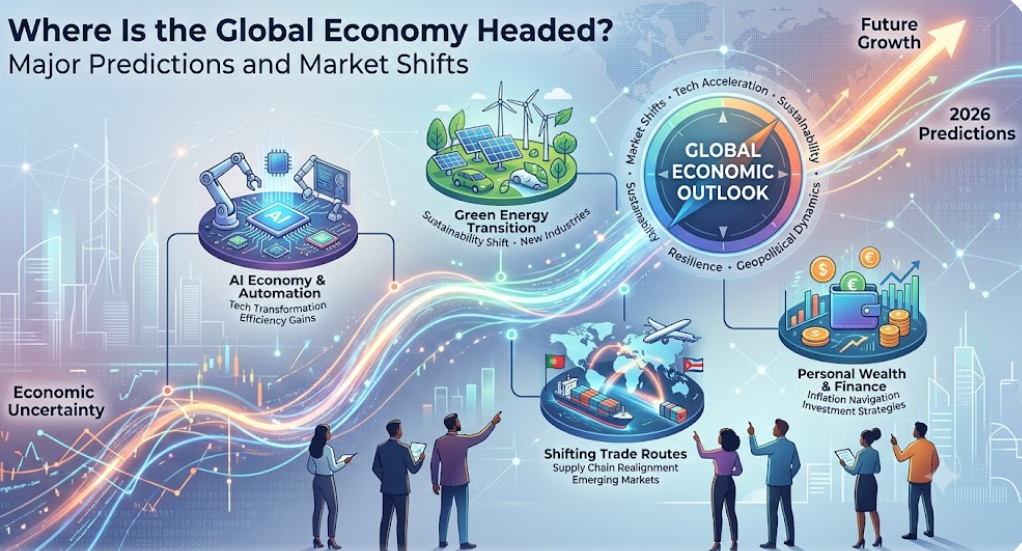
The global economy has entered a period of rapid transformation. Inflation, rising interest rates, technological innovation, geopolitical tensions, and changing consumer behavior are reshaping how countries and businesses operate. While some economies are showing signs of recovery, others continue to face uncertainty due to debt, trade disruptions, and slower growth.
For businesses, investors, and everyday consumers, understanding where the global economy is headed has never been more important. Although no one can predict the future with complete certainty, several economic trends are already pointing toward significant market shifts over the next few years.
Let’s explore the major predictions that could define the global economy and what they may mean for individuals and businesses alike.
1. Global Economic Growth Will Likely Slow—but Not Stop
Most economists expect moderate growth rather than rapid expansion. After years of inflation and aggressive interest rate hikes by central banks, many countries are entering a phase of slower but more stable economic activity.
Developed economies may experience slower GDP growth as consumers reduce spending and businesses become more cautious with investments. Emerging markets, however, could continue growing faster due to younger populations, expanding industries, and increasing digital adoption.
Instead of expecting a global recession, many analysts believe the world economy is moving toward a period of steady, sustainable growth.
2. Artificial Intelligence Will Become a Major Economic Driver
Artificial Intelligence (AI) is no longer just a technology trend—it’s becoming an economic force.
Companies across industries are using AI to:
- Improve productivity
- Reduce operational costs
- Automate repetitive tasks
- Enhance customer experiences
- Increase data-driven decision making
Businesses that successfully adopt AI are expected to gain a competitive advantage, while companies that delay digital transformation may struggle to keep pace.
Governments are also investing heavily in AI infrastructure, making it one of the biggest growth sectors of the coming decade.
3. Interest Rates May Gradually Decline
Central banks raised interest rates to control inflation, making borrowing more expensive for consumers and businesses.
If inflation continues to ease, many economists expect central banks to slowly reduce interest rates.
Lower interest rates could lead to:
- Increased business investments
- Stronger housing markets
- Higher consumer spending
- Better access to loans
- Improved stock market sentiment
However, rate cuts are likely to happen gradually rather than all at once.
4. Supply Chains Will Continue to Diversify
The COVID-19 pandemic exposed weaknesses in global supply chains. Since then, companies have started reducing dependence on single manufacturing hubs.
Many multinational businesses are expanding production into countries such as:
- India
- Vietnam
- Mexico
- Indonesia
This strategy helps reduce risk while improving supply chain resilience.
India, in particular, is becoming an attractive manufacturing destination thanks to government incentives, infrastructure development, and a growing skilled workforce.
5. Green Energy Investments Will Accelerate
Climate change is becoming an economic issue as much as an environmental one.
Governments and private investors are allocating billions of dollars toward:
- Solar energy
- Wind power
- Electric vehicles
- Battery technology
- Hydrogen fuel
- Sustainable infrastructure
The clean energy sector is expected to create millions of new jobs while reducing dependence on fossil fuels.
Companies focusing on environmental sustainability may also attract greater investor confidence in the coming years.
6. Emerging Markets Could Lead Future Growth
Countries such as India, Brazil, Indonesia, and several African nations are expected to play a larger role in the global economy.
Reasons include:
- Growing middle-class populations
- Rapid urbanization
- Increasing internet penetration
- Expanding manufacturing industries
- Higher consumer spending
As developed economies mature, emerging markets are likely to contribute a larger share of global GDP growth.
7. Consumer Spending Habits Are Changing
Modern consumers are becoming more selective about how they spend money.
People are increasingly prioritizing:
- Experiences over luxury goods
- Digital services
- Subscription-based products
- Sustainable brands
- Health and wellness
Businesses that understand changing consumer preferences are more likely to remain competitive.
Companies relying on outdated business models may struggle to retain customers.
8. Digital Payments Will Continue Replacing Cash
Cashless transactions have become common across many countries.
Digital payment systems—including mobile wallets, instant bank transfers, and contactless payments—continue to expand.
Benefits include:
- Faster transactions
- Better financial inclusion
- Improved business efficiency
- Reduced cash handling costs
Many governments are also exploring Central Bank Digital Currencies (CBDCs), which could further modernize financial systems.
9. Geopolitical Risks Will Remain a Major Challenge
Global economic growth doesn’t happen in isolation.
Several ongoing factors may continue influencing markets:
- International trade disputes
- Regional conflicts
- Energy price volatility
- Political instability
- Cybersecurity threats
Businesses are increasingly building contingency plans to manage unexpected disruptions and reduce operational risks.
10. Investors Are Becoming More Diversified
Recent market volatility has encouraged investors to spread investments across different asset classes.
Instead of relying only on stocks, many portfolios now include:
- Bonds
- Gold
- Real estate
- Exchange-Traded Funds (ETFs)
- Infrastructure investments
- International equities
Diversification helps reduce risk during periods of economic uncertainty.
Opportunities Businesses Should Watch
Despite global challenges, several industries appear well-positioned for long-term growth.
These include:
- Artificial Intelligence
- Renewable Energy
- Healthcare Technology
- Cybersecurity
- Cloud Computing
- Financial Technology (FinTech)
- Electric Vehicles
- Semiconductor Manufacturing
Companies operating in these sectors could benefit from increasing global demand over the next decade.
What This Means for Everyday Consumers
The future economy isn’t just about governments or multinational corporations.
Consumers can prepare by:
- Building emergency savings
- Improving financial literacy
- Learning digital and AI-related skills
- Investing with a long-term perspective
- Managing debt responsibly
- Staying informed about economic changes
Economic conditions may fluctuate, but individuals who adapt to changing markets often remain financially stronger.
Conclusion
The global economy is entering a new phase shaped by technology, sustainability, demographic changes, and evolving consumer behavior. While short-term uncertainty will remain, long-term opportunities continue to emerge for businesses, investors, and professionals willing to adapt.
Rather than expecting a return to the economic patterns of the past, the future is likely to be more digital, interconnected, and innovation-driven. Those who stay informed, embrace change, and make thoughtful financial decisions will be better positioned to succeed in the years ahead.
Frequently Asked Questions (FAQs)
1. What is the biggest factor shaping the global economy today?
Artificial intelligence, inflation trends, geopolitical developments, and changing supply chains are among the biggest forces influencing the global economy.
2. Which countries are expected to drive future economic growth?
Emerging economies such as India, Indonesia, Brazil, and several African nations are expected to contribute significantly to future global growth.
3. Will inflation continue to affect consumers?
Inflation has eased in many regions, but prices may remain higher than pre-pandemic levels. Consumers should continue budgeting carefully and monitor changes in interest rates.
4. Is AI changing the global job market?
Yes. AI is automating repetitive tasks while also creating demand for new skills in technology, data analysis, cybersecurity, and digital services.
5. Why are companies moving manufacturing away from a single country?
Businesses are diversifying supply chains to reduce risks from geopolitical tensions, trade disruptions, and future global crises.
6. What sectors are expected to grow the fastest over the next decade?
Artificial intelligence, renewable energy, healthcare technology, cybersecurity, fintech, electric vehicles, and semiconductor manufacturing are widely expected to experience strong long-term growth.
7. How can individuals prepare for future economic changes?
Developing new skills, maintaining emergency savings, investing wisely, reducing unnecessary debt, and staying informed about economic trends can help individuals navigate future market changes.
Author

Freshmediarecord01@gmail.com
Related Posts

What Happens During a Professional Pest Inspection?
- 0
- 1,556 word
Seeing an ant trail, hearing scratching inside a wall, or finding insect wings near a window can leave you wondering how serious...
Read out all
Why Every Marketer Is Secretly Relying on Social Growth Platforms
- 0
- 1,178 word
Building a strong social media presence has become more challenging than ever. Every day, millions of posts compete for attention across Instagram,...
Read out all
How AI and New Supply Chains Are Quietly Changing Our Kitchens
- 0
- 1,209 word
How AI and New Supply Chains Are Quietly Changing Our Kitchens Introduction The modern kitchen is evolving faster than most people realize....
Read out all
Which Hotel Price Tracker Is Actually Worth Using for Business Travel?
- 0
- 1,160 word
Business travel comes with tight schedules, fixed budgets, and constant pressure to keep costs under control. While airlines often receive the most...
Read out all
Preseason Position Battles That Will Decide Fantasy Football Drafts
- 0
- 1,136 word
Fantasy football championships aren’t won on draft day—they’re won by identifying value before everyone else does. Every NFL preseason brings exciting position...
Read out all
How AI and Robotics Are Changing Metal Fabrication in 2026
- 0
- 1,068 word
The metal fabrication industry has always been driven by innovation. From manual welding to CNC machines, every technological advancement has helped manufacturers...
Read out all