
- 0
- 1,068 word
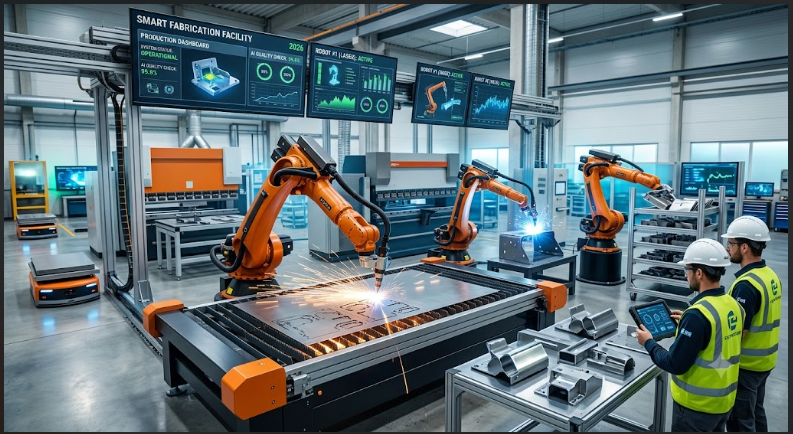
The metal fabrication industry has always been driven by innovation. From manual welding to CNC machines, every technological advancement has helped manufacturers produce stronger, more accurate, and cost-effective products. In 2026, another major transformation is taking place. Artificial Intelligence (AI) and robotics are no longer futuristic concepts—they have become essential tools in modern metal fabrication facilities.
Manufacturers are adopting smart automation to improve production speed, reduce waste, enhance worker safety, and maintain consistent product quality. Whether producing automotive parts, construction materials, aerospace components, or industrial machinery, AI-powered systems and intelligent robots are reshaping the entire fabrication process.
Let’s explore how AI and robotics are revolutionizing metal fabrication in 2026 and what this means for businesses, workers, and the future of manufacturing.
Why AI and Robotics Matter in Metal Fabrication
Traditional fabrication processes often rely on skilled operators for cutting, welding, bending, polishing, and quality inspections. While experienced workers remain essential, AI now helps manufacturers make faster and more accurate decisions.
Robotic systems combined with AI can:
- Work continuously with minimal downtime
- Perform repetitive tasks with extreme precision
- Detect defects instantly
- Reduce production costs
- Improve workplace safety
- Optimize material usage
Instead of replacing human workers entirely, AI and robotics are helping employees focus on higher-value tasks that require creativity, planning, and problem-solving.
AI-Powered Smart Manufacturing
Artificial Intelligence analyzes massive amounts of production data in real time. Modern fabrication facilities use AI software to monitor every stage of manufacturing.
Some important applications include:
Predictive Maintenance
Machines no longer wait until something breaks.
AI continuously monitors:
- Temperature
- Motor vibration
- Tool wear
- Energy consumption
- Machine performance
When abnormal behavior is detected, the system alerts technicians before equipment fails. This minimizes expensive downtime and extends machine life.
Production Scheduling
AI automatically organizes production schedules based on:
- Customer orders
- Material availability
- Machine capacity
- Delivery deadlines
This improves workflow while reducing idle time across the factory floor.
Intelligent Robotic Welding
Welding remains one of the most important fabrication processes.
In 2026, AI-enabled robotic welding systems have become significantly smarter.
These robots can:
- Automatically adjust welding parameters
- Detect material thickness
- Adapt to different joint designs
- Correct alignment errors
- Produce highly consistent welds
Unlike traditional robotic systems that required extensive programming, modern AI robots learn from previous welds and improve over time.
This results in:
- Better weld quality
- Fewer defects
- Faster production
- Lower rework costs
Computer Vision for Quality Inspection
Quality control has become far more accurate with AI-powered computer vision.
Instead of relying solely on manual inspection, high-resolution cameras combined with AI scan every manufactured part.
The system instantly identifies:
- Surface cracks
- Incorrect dimensions
- Poor weld quality
- Scratches
- Material defects
Even microscopic imperfections that human inspectors might miss can be detected within seconds.
This ensures customers receive consistently high-quality fabricated products.
Smarter CNC Machines
Modern CNC machines are becoming increasingly intelligent.
AI can automatically:
- Select optimal cutting speeds
- Adjust feed rates
- Reduce tool wear
- Improve machining accuracy
- Minimize material waste
Instead of operators manually adjusting settings, AI continuously optimizes machining conditions based on real-time sensor data.
This improves productivity while lowering manufacturing costs.
Automated Material Handling
Moving heavy metal sheets and fabricated components has always been physically demanding.
Robotic material handling systems now perform tasks such as:
- Loading raw materials
- Unloading finished parts
- Organizing inventory
- Transporting components
- Packaging finished products
Autonomous Mobile Robots (AMRs) and Automated Guided Vehicles (AGVs) safely transport materials throughout fabrication facilities without human intervention.
This reduces workplace injuries and speeds up production.
AI Improves Design and Engineering
AI is transforming product design before fabrication even begins.
Engineers use AI software to:
- Optimize product designs
- Reduce material usage
- Improve structural strength
- Simulate stress conditions
- Identify manufacturing challenges early
Instead of producing multiple physical prototypes, digital simulations help engineers perfect designs virtually.
This shortens development time and lowers overall production costs.
Digital Twins Are Becoming Standard
A Digital Twin is a virtual replica of a real manufacturing system.
In 2026, many fabrication plants use Digital Twin technology to monitor production in real time.
Manufacturers can:
- Simulate production changes
- Test machine settings
- Predict maintenance needs
- Improve workflow efficiency
- Analyze factory performance
Because everything is tested virtually first, businesses reduce costly production errors.
Enhanced Worker Safety
Safety remains one of the biggest advantages of AI and robotics.
Robots now perform hazardous tasks involving:
- Heavy lifting
- High-temperature welding
- Toxic fumes
- Sharp metal cutting
- Repetitive operations
Meanwhile, AI safety systems monitor worker movement and automatically stop machines if someone enters a dangerous area.
This significantly reduces workplace accidents while creating safer environments for employees.
Sustainability and Reduced Waste
Environmental sustainability has become a major priority across manufacturing industries.
AI helps reduce waste by optimizing:
- Raw material usage
- Energy consumption
- Machine efficiency
- Scrap recycling
- Production planning
Manufacturers produce more products while consuming fewer resources.
This lowers operating costs while supporting global sustainability goals.
Human Workers Are Still Essential
Despite rapid automation, skilled workers remain critical.
AI cannot fully replace experienced professionals who handle:
- Complex fabrication planning
- Engineering decisions
- Customer communication
- Custom manufacturing
- Equipment maintenance
- Creative problem-solving
Instead, AI acts as an intelligent assistant that helps workers perform their jobs more efficiently.
The future workforce will combine technical expertise with AI-powered tools.
Challenges of AI Adoption
Although AI offers enormous benefits, implementation is not without challenges.
Common obstacles include:
- High initial investment
- Employee training requirements
- Integration with existing equipment
- Cybersecurity concerns
- Data management complexity
However, many manufacturers find that long-term productivity gains outweigh these initial costs.
What the Future Looks Like
Looking ahead, AI and robotics will continue advancing rapidly.
Future innovations may include:
- Fully autonomous fabrication facilities
- AI-driven production planning
- Collaborative robots working alongside humans
- Advanced 3D metal printing with AI optimization
- Self-learning manufacturing systems
- Predictive supply chain management
As technology becomes more affordable, even small and medium-sized fabrication businesses will benefit from intelligent automation.
In 2026, AI and robotics are transforming metal fabrication into a smarter, faster, and more efficient industry. From robotic welding and intelligent CNC machining to predictive maintenance and AI-powered quality inspection, these technologies are improving every stage of production.
Rather than replacing skilled workers, AI enhances human capabilities by handling repetitive and hazardous tasks while providing valuable insights for better decision-making. Companies that embrace intelligent automation today will be better positioned to compete in an increasingly technology-driven manufacturing landscape.
The future of metal fabrication is not simply automated—it is intelligent. Businesses that invest in AI and robotics now are laying the foundation for higher productivity, improved quality, greater sustainability, and long-term success in the years ahead.
Author

Freshmediarecord01@gmail.com
Related Posts
What Happens During a Professional Pest Inspection?
- 0
- 1,556 word
Seeing an ant trail, hearing scratching inside a wall, or finding insect wings near a window can leave you wondering how serious...
Read out all
Why Every Marketer Is Secretly Relying on Social Growth Platforms
- 0
- 1,178 word
Building a strong social media presence has become more challenging than ever. Every day, millions of posts compete for attention across Instagram,...
Read out all
How AI and New Supply Chains Are Quietly Changing Our Kitchens
- 0
- 1,209 word
How AI and New Supply Chains Are Quietly Changing Our Kitchens Introduction The modern kitchen is evolving faster than most people realize....
Read out all
Which Hotel Price Tracker Is Actually Worth Using for Business Travel?
- 0
- 1,160 word
Business travel comes with tight schedules, fixed budgets, and constant pressure to keep costs under control. While airlines often receive the most...
Read out all
Preseason Position Battles That Will Decide Fantasy Football Drafts
- 0
- 1,136 word
Fantasy football championships aren’t won on draft day—they’re won by identifying value before everyone else does. Every NFL preseason brings exciting position...
Read out all
Where Is the Global Economy Headed? Major Predictions and Market Shifts
- 0
- 1,190 word
The global economy has entered a period of rapid transformation. Inflation, rising interest rates, technological innovation, geopolitical tensions, and changing consumer behavior...
Read out all